PCB surface finish guide: HASL vs ENIG vs OSP
How to choose a PCB surface finish — HASL, ENIG, and OSP compared on cost, flatness, shelf life, and fine-pitch capability.
Engineering review by Huitai Engineering Team
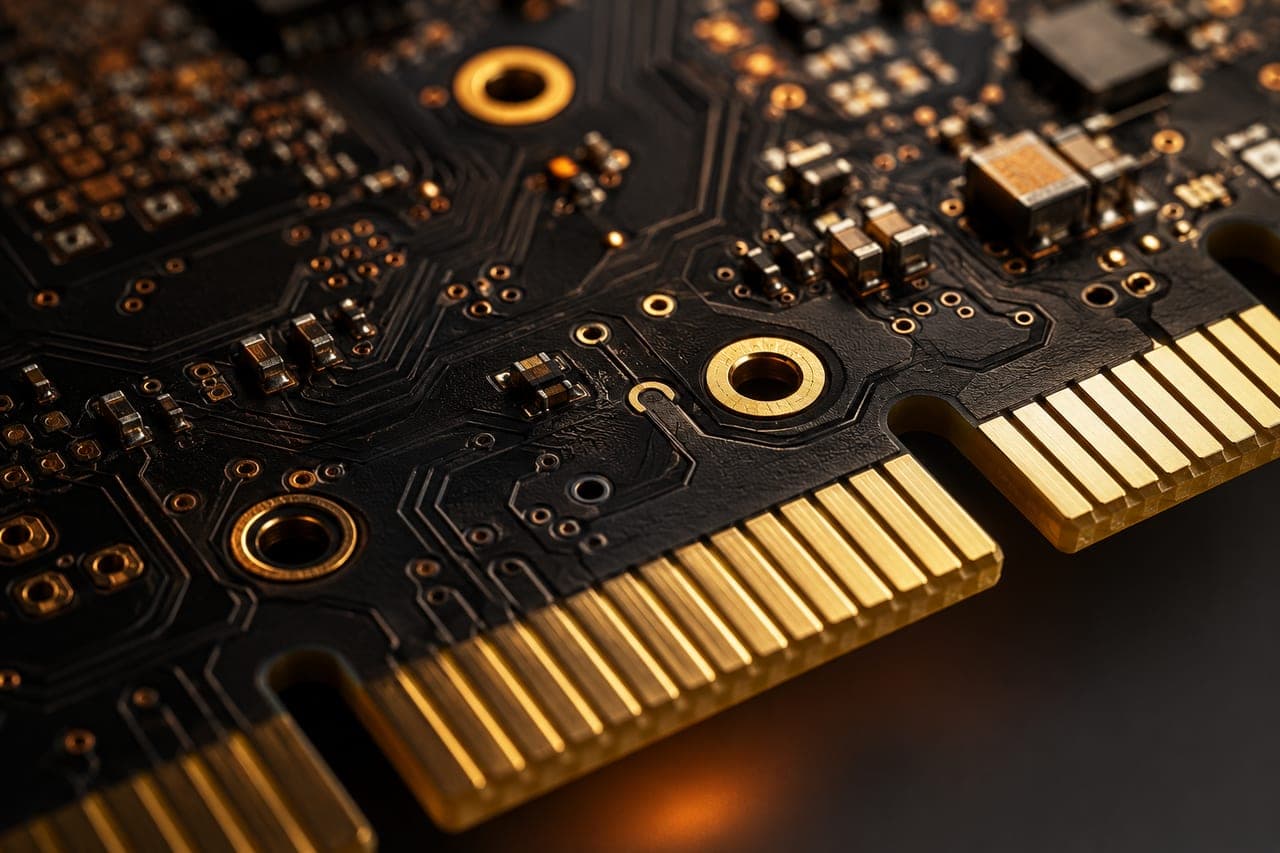
What a surface finish does
The surface finish is the coating on a bare board’s exposed copper pads. Its job is to protect the copper from oxidation before assembly and to give a solderable surface for the components. The finish affects cost, shelf life, how flat the pads are (which matters for fine-pitch parts), and assembly yield.
For a turnkey PCBA project there is no single “best” finish — the right one depends on your component types, quantity, storage time, and budget.
HASL — the low-cost default
HASL (Hot Air Solder Leveling) coats the pads with solder, then levels it with hot air. It is the most common and lowest-cost finish, with excellent solderability and a long shelf life.
The trade-off is a slightly uneven, domed pad surface, which is not ideal for fine-pitch QFN or BGA parts. Lead-free HASL is often selected when RoHS-related requirements apply, but the surface finish alone does not establish product compliance. HASL is a common option for standard boards with larger pads.
ENIG — flat and reliable
ENIG (Electroless Nickel Immersion Gold) plates the copper with nickel and a thin layer of gold. It gives a very flat surface, making it the preferred choice for fine-pitch components, QFN, and BGA. It also has a long shelf life (often 12 months or more) and good corrosion resistance.
ENIG costs more than HASL or OSP, but for dense, high-reliability boards it is usually worth it — many IoT and smart-display assemblies use ENIG for this reason.
OSP — cheap and flat, but time-sensitive
OSP (Organic Solderability Preservative) is a thin organic coating over the copper. It is low-cost, flat, and environmentally friendly, with good solderability for boards that will be assembled soon.
Its limits are a shorter shelf life and tolerance for fewer reflow cycles, and it is hard to inspect visually (no metallic coating to see). OSP suits cost-sensitive boards assembled within a few months.
Other options: Immersion Silver and Tin
Immersion Silver and Immersion Tin are flat, fine-pitch-friendly alternatives with moderate cost, though both are more sensitive to handling and storage.
They are less common than the three above, but available when a specific assembly, contact, or press-fit requirement calls for them.
Which finish should you choose?
A quick rule of thumb: consider lead-free HASL for standard, cost-sensitive boards with larger pads; ENIG for fine-pitch, BGA, high-reliability, or longer storage; OSP for low-cost boards assembled soon. Surface finish selection depends on product requirements, assembly process, shelf life, and compliance needs. See our fabrication and assembly capabilities for the finishes we coordinate.
RoHS-related material requirements should be confirmed before quotation. Material declarations or compliance documents should be discussed project by project when required.
Not sure which fits your design? Send your Gerber and BOM and our engineering team will recommend a finish based on your components, quantity, and storage needs — reply within 24h.