
Establishing the PCBA scope
The customer first sent the design files, then supplied the BOM on September 19. We confirmed that the project required assembled boards and organized the information needed for component procurement and assembly.
The design used a two-layer PCB with through-hole components throughout, including DIP-packaged ICs. The original BOM contained reference designators, quantities and footprints, but some entries used generic descriptions or incomplete part designations. The supplier asked about buzzer voltage and active or passive operation, capacitor mounting style, and header configuration.
The headers needed particular attention: the list included 1×2 right-angle, 1×2 straight and 2×3 straight versions. Interface names explained their purpose, while purchasing required the corresponding component specification.
Sending the customer a confirmation table
On September 20, the customer supplied a PDF with parameter notes. We combined the original BOM, those answers and the supplier's questions in a confirmation table, keeping the original reference designators and quantities. That afternoon, we sent the table back for completion.
Questions sat beside the relevant components. They covered capacitor voltage ratings, resistor power ratings, LED colors, header configurations, the MCU's full ordering code, and requirements for the buzzer and crystal. This gave us a place to carry the customer's answers into the purchasing list.
For example, the customer specified through-hole ceramic capacitors rated for at least 25V for the 100nF and 330nF entries, and at least 50V for the 22pF entry. The resistors were specified as through-hole, 0.25W parts. We recorded those parameters in their respective rows for candidate review.
The completed table came back on the afternoon of September 21. All 15 rows marked as requiring confirmation had a response. We used each answer within its stated scope: where a response confirmed the package, the exact candidate part still needed its own review.
Reading the recommendations row by row
The platform recommendations exposed a mismatch. Three ceramic-capacitor input rows specified THT packages, yet the suggested products were surface-mount capacitors. Headers with different through-hole configurations had also been matched to the same surface-mount connector.
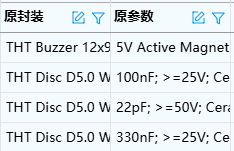
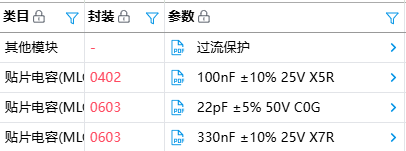
Corresponding rows from the same screenshot. The input specifies THT; the recommendations include 0402 and 0603 surface-mount packages.
We revisited those candidates. A matching capacitance value could still leave a difference in mounting style, dimensions or pin arrangement. The customer permitted equivalent parts for ordinary components, subject to electrical specifications and PCB-package compatibility. We used those conditions to guide the review and kept unresolved checks in the working list.
Correcting our spreadsheet and import fields
Some of the difficulty came from our own early spreadsheet. Parameters and part designations shared a column. After import, purchasing notes appeared in the brand field and the package field was empty. Requirements already present in the documents had not reached the right purchasing fields.
We separated manufacturer part number, brand, package, specifications, platform product code, quantity per assembly and reference designators. Entries with an identified candidate received a part number or code. Others retained their specifications and open checks. Interface names moved into the notes.
We also split one LED row into four color groups while preserving the total LED quantity of 9. This took the BOM from 23 grouped rows to 26. Across the original BOM, supplier question table, customer confirmation table and revised import list, we checked that the same 52 unique reference designators remained, each appearing once, with a total component quantity of 52 per board. The extra rows reflected the grouping change; 26 rows did not mean 26 distinct purchasing part numbers.
Keeping the remaining exceptions visible
Two import screenshots each counted 26 rows. One showed 14 rows marked as fully matched; the later screenshot showed 24, with one awaiting confirmation and one unmatched.


The two platform status bars, with their original labels and counts.
The later count, 24/26 or 92.3%, describes that platform state only. It is not a production yield or a measure of purchasing completion. We still needed to check the package and electrical requirements of the individual parts.
Some resistor entries still lacked an exact part number. Mounting dimensions and crystal drive conditions also required further review. We kept those checks in the relevant rows for the next stage of component selection.
Arranging the prototype order
After receiving the completed table, we incorporated the replies into the BOM. That afternoon, we told the customer the BOM was ready and sent the English version for quotation and sourcing discussions. The customer replied that they wanted to start with five boards.
Later that day, we quoted for five PCBA prototypes. The customer accepted the quotation and placed the order, and we arranged the prototype build on that basis. The purchasing list retained the clarified requirements, reference designators and outstanding checks for the work ahead.
This account ends with the order and prototype arrangements. Prototype completion, testing and delivery results are outside this record.