PCBA Testing Before Shipment in a Turnkey Manufacturing Workflow
How testing fits into Huitai PCB’s one-stop PCBA workflow, from PCB fabrication and BOM sourcing through SMT/DIP assembly, inspection, packaging, and delivery.
Engineering review by Huitai Engineering Team
Quick answer
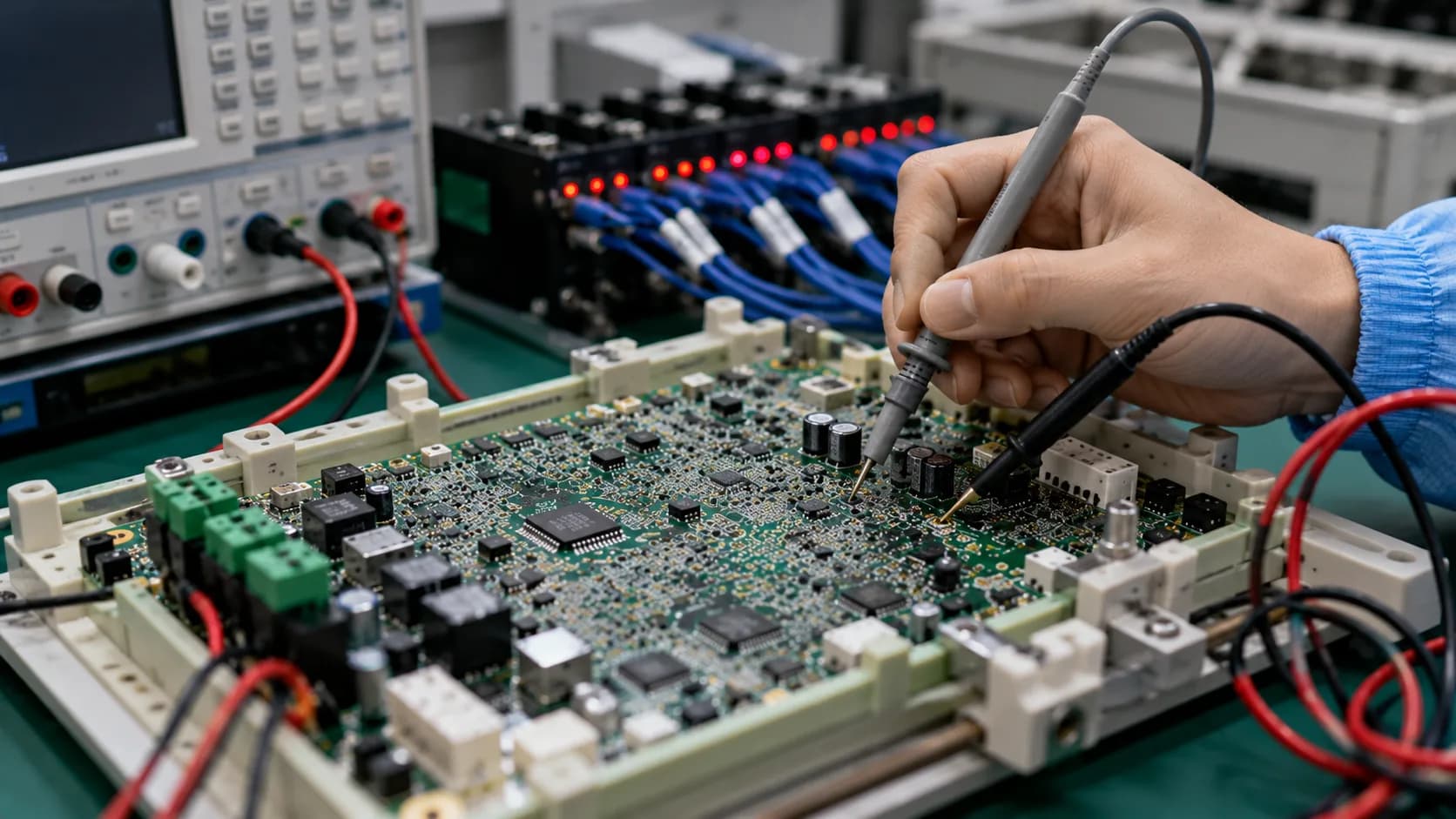
PCBA testing before shipment is a quality-control stage inside a turnkey manufacturing workflow, not a standalone description of Huitai PCB’s service. The complete one-stop scope can coordinate PCB fabrication, BOM sourcing, SMT and through-hole (DIP) assembly, inspection and functional testing to confirmed requirements, packaging, and finished PCBA delivery.
Within that workflow, visual inspection and AOI look for visible assembly problems such as missing or misaligned components, polarity errors, solder bridges, and other optical defects. Functional testing checks customer-defined board behavior using confirmed firmware, fixtures, operating conditions, and pass/fail criteria.
Where testing fits in turnkey PCBA
Testing is one quality gate in a connected manufacturing path. Reviewing it together with fabrication, sourcing, and assembly helps prevent a test requirement from appearing only after boards have already been built.
| Turnkey stage | Coordinated scope | Buyer input or approval | Result |
|---|---|---|---|
| Engineering review | Review Gerber, BOM, pick-and-place data, drawings, quantity, testing, and delivery needs | Latest file revisions and answers to open engineering questions | Confirmed quotation scope and identified risks |
| PCB fabrication | Coordinate bare-board production to the confirmed PCB specifications | Stack-up, material, thickness, copper, finish, dimensions, and special notes | Fabricated PCBs ready for assembly |
| BOM sourcing | Review part availability, lifecycle risk, and customer-approved alternatives | Manufacturer part numbers, no-substitute parts, and alternative approvals | Components purchased for the build |
| SMT and DIP assembly | Coordinate stencil, placement, reflow, and through-hole assembly requirements | Pick-and-place data, assembly drawings, polarity, and mechanical notes | Assembled PCBA boards |
| Inspection and testing | Apply agreed visual inspection, AOI, and customer-defined functional testing | Firmware, fixture, interfaces, test steps, and acceptance criteria | Boards checked to the confirmed quality scope |
| Packaging and delivery | Prepare labels, packaging, handling, and shipment requirements | Label format, packaging notes, destination, and delivery instructions | Finished PCBA delivery |
This is the role of testing in a turnkey PCB assembly project: it supports the delivery of finished boards after the earlier fabrication, sourcing, and assembly stages have been coordinated.
AOI, visual inspection, and functional testing compared
| Inspection or test | What it can find | What it does not confirm | Buyer input needed |
|---|---|---|---|
| Visual inspection | Damage, contamination, labels, polarity, orientation, and visible solder issues | Repeatable electrical or product function | Assembly drawing, reference photos, and workmanship notes |
| AOI | Missing, shifted, rotated, or wrong-polarity parts and visible solder defects | Firmware, signal performance, hidden connections, or complete product behavior | Component data, polarity references, and inspection scope |
| Basic power-on or continuity check | Shorts, unexpected current draw, or a defined basic response | Full feature or performance coverage | Power limits, connection method, expected readings, and safety notes |
| Functional testing | Defined power, communications, inputs, outputs, sensors, or controls | Any function outside the approved sequence | Firmware, fixture, interfaces, test steps, expected results, and limits |
The right combination depends on board complexity, project stage, failure risk, and the evidence required before shipment.
An AI camera, edge gateway, robotics controller, or smart sensor may need additional programming, load, interface, and runtime checks; see the edge AI PCB assembly guide for a scoped example.
What AOI can and cannot check
AOI provides repeatable optical screening after SMT placement and reflow. It compares component presence, position, polarity markings, and visible solder conditions against programmed criteria.
AOI only evaluates visible conditions included in its program. It cannot prove that a microcontroller starts, a port communicates, a sensor responds, or a power rail stays within tolerance under load. Critical hidden connections may need another agreed method. See common PCBA defects and how to prevent them for a broader risk overview.
What customers should provide for a turnkey PCBA review
Start with one complete RFQ package: Gerber and drill files, a BOM with manufacturer part numbers, pick-and-place data, assembly drawings, PCB specifications, quantity, delivery requirements, and any packaging or labeling notes. These inputs define the fabrication, sourcing, assembly, and finished-delivery scope before testing is added.
When functional testing is required, also provide the conditions for powering, programming, exercising, measuring, and accepting the board:
- Firmware: approved revision, programming file, steps, and configuration requirements.
- Power: voltage, current limit, polarity, startup sequence, and prohibited conditions.
- Fixture and interfaces: fixture, connectors, cables, adapters, protocols, and instruments.
- Test sequence: actions, inputs, delays, measurements, and reset conditions.
- Expected results: target readings, tolerances, messages, indicators, or waveforms.
- Reference evidence: golden sample, approved log, screenshot, or known-good measurement.
- Records and handling: required traceability plus relevant electrical, thermal, or mechanical precautions.
If some inputs are unavailable, the project can still define a narrower inspection or basic check where appropriate, but it should not be described as complete functional validation. The exact quality and testing scope must be confirmed for the project.
Functional test specification template
A controlled specification is more useful than an instruction such as "test the board." These fields make the method repeatable and quotation assumptions visible.
| Field | What to define | Example |
|---|---|---|
| Test ID and revision | Stable step name and document version | FCT-03, revision B |
| Preconditions | Firmware, board state, or setup | Approved firmware loaded |
| Fixture and equipment | Required fixture, cable, instrument, or software | Customer fixture and cable set |
| Input or action | Operator or station action | Apply input and send the command |
| Expected result | Response to observe | Specified status and output state |
| Tolerance | Permitted numerical or timing range | Approved engineering limit |
| Pass/fail rule | Exact acceptance condition | All mandatory steps within limits |
| Data to record | Values, logs, serial numbers, or failure codes | Serial, firmware, value, and result |
| Failure and retest rule | Action after failure | Isolate and follow approved disposition |
Replace these examples with real product conditions and control the revision so both parties use the same definition.
Confirm the testing scope before quotation
A turnkey PCBA quote should define the complete path from PCB fabrication and BOM sourcing through assembly, inspection, testing, packaging, and delivery. Within that scope, fixtures, programming, connection time, software setup, data retention, and retesting add project-specific work.
Confirm the methods, coverage, fixture and software owner, controlling revision, required records, and failure process. Coverage must be explicit; never infer it from the word "tested." Prototype builds may validate the method, while repeat builds need controlled firmware and test revisions.
For turnkey PCB assembly, review testing with fabrication, sourcing, assembly, packaging, and delivery. The PCBA testing and quality control service page explains how project-specific scope is coordinated.
Define failure handling and retesting
Define what happens after a failure so troubleshooting, rework, and retesting do not introduce uncontrolled decisions.
- Identify and isolate the failed board.
- Record the failed test ID and required reading, message, photo, or log.
- Define diagnosis scope and changes that require customer approval.
- State the rework instruction or approval path.
- Retest under the same controlled conditions.
- Define the disposition for unresolved failures.
Name required reports, serial-number logs, failure summaries, or retained data in the quotation instead of assuming they are included.
Pre-shipment PCBA testing checklist
Before the build is released, confirm the following items:
- Gerber, BOM, pick-and-place data, drawings, specifications, and quantities use the intended revision.
- Component availability, no-substitute parts, and approved alternatives are confirmed.
- Firmware and programming instructions have an approved version.
- Power limits, interfaces, and handling precautions are documented.
- Fixture, equipment, software, and ownership are confirmed.
- Each mandatory test step has an expected result and pass/fail limit.
- Coverage, records, failure handling, rework, and retest rules are agreed.
- Labeling, packaging, delivery details, and final visual checks are included.
Use this checklist as a shared starting point, then adapt it to the board and project risk.
FAQ
Is AOI the same as functional testing?
No. AOI checks visible assembly conditions. Functional testing checks defined board behavior using confirmed firmware, fixtures, inputs, outputs, and limits.
Can AOI confirm that a PCBA works?
No. A board can pass AOI and still have a firmware, communication, power, sensor, or interface problem.
What information is needed for PCBA functional testing?
Provide firmware, programming steps, power conditions, fixture and interface details, test sequence, expected results, tolerances, pass/fail criteria, and record requirements.
Does every assembled board need functional testing?
Coverage depends on product risk, project stage, buyer requirements, and the agreed quality plan. The quote should state whether every board or an agreed sample is tested.
Can Huitai help with a functional test fixture?
Fixture requirements can be discussed. Responsibility, cost, lead time, interfaces, maintenance, and acceptance must be confirmed before production.
What test records should a buyer request?
Request the evidence the project needs, such as serial numbers, firmware revisions, values, pass/fail logs, failure codes, retest results, or a summary report.
What does Huitai coordinate in a turnkey PCBA project?
Huitai PCB coordinates PCB fabrication, BOM sourcing, SMT and through-hole (DIP) assembly, inspection and functional testing to confirmed requirements, packaging, and finished PCBA delivery as one managed project scope.
Send your complete turnkey PCBA package for review
A useful one-stop review package combines production files, sourcing requirements, assembly notes, testing inputs, packaging, and delivery needs. Include Gerber and drill data, BOM, pick-and-place data, assembly drawings, PCB specifications, quantity, firmware, fixture or interface notes, test steps, acceptance criteria, and delivery requirements.
Send your complete turnkey PCBA package for a manufacturing review. Huitai PCB reviews PCB fabrication, BOM sourcing, SMT/DIP assembly, inspection and functional testing, packaging, and finished PCBA delivery as one coordinated quotation scope.